The Man Who Sold Hollywood the Internet
How a British-raised entrepreneur built IMDb’s US operation from a hard disk in Wisconsin — and talked 20th Century Fox into the first real internet ad campaign a studio ever bought.

In the spring of 1996, a database of movie trivia assembled by obsessives on Usenet made its bid to become a business. It had no US office, no sales team, and no revenue model — just the largest film catalog on the internet and an audience that had built itself. What it needed was someone who could turn traffic into a company. It found Tim de Vallée.
De Vallée’s own path to that moment ran through three countries before he ever saw a line of the IMDb database. Born in New York City, he was raised in London in a household that ran on translation: his mother worked as an interpreter at the United Nations, and by age six he was speaking five languages without having been formally taught any of them — they were simply what was in the room. His father was president of Chase Manhattan Bank’s London operation, a posting that kept the family in motion and left de Vallée fluent in the particular skill of reading rooms he hadn’t grown up in. He was educated at Hill House School, the same London institution that had once schooled Prince Charles, and later won a scholarship to Oxford.
Computers arrived almost by accident. His first machine was a Mac 512K. By 1989 he was working at Astley Systems in Chelsea Harbour, an Apple partner, at the precise moment computing was shifting from private hobby to unnamed career. It was in London, not Hollywood, that he met the founders of the Internet Movie Database. The first meeting was at Soho House with IMDb’s Alan Jay — a site that, at the time, was pulling more traffic than Yahoo, then the leading website on the internet. What it had was an audience nobody was selling. What it lacked was anyone who could.
An offer with no floor
What IMDb’s founders needed was concrete: a US legal presence, a commercial operation, and someone who could get into rooms in Los Angeles on their behalf. What they offered was less so. The role was full-time and commission-only — no salary, no draw, no guaranteed income of any kind. De Vallée would be paid exactly as much as he could sell of a product that had never been sold before, in a category that, as of 1995, did not commercially exist.
He took it. The audience, he reasoned, was already real; someone simply had to build the apparatus to convert it into money.
That timing mattered more than it might now appear. Internet advertising in early 1996 had no rate cards, no agreed measurement standards, and no agency desks equipped to process a media buy that involved neither print nor airtime. De Vallée’s connections got IMDb into executive offices on Sunset Boulevard, in the 90210 zip — and he financed the entire operation himself. The address did commercial work far beyond its zip code. A studio marketing department could dismiss a website. It could not as easily dismiss what now looked like a well-established, legitimate, funded company with offices on Sunset. From there he took meetings with the people behind the Academy Awards and pitched every major studio in Hollywood, making certain each one knew he was in town and exactly what he intended to do: sell advertising on IMDb.com. With no external agency capable of selling a product nobody understood, he built one in-house: inventory, creative, pricing, pitch materials, invented from scratch because no precedent existed to borrow from.

The hardware and the sale
The company’s technical origin story has been told for thirty years: co-founder Col Needham bought IMDb’s first web server on his own credit card, loaded the operating system, the site software and the entire database onto a single 4GB hard disk, and shipped it by FedEx to a volunteer in Wisconsin, who installed it at a local ISP in exchange for a promotional link on the IMDb home page. The launch was timed deliberately to the 1996 Academy Awards — the one weekend of the year the largest film database on earth could count on the whole country arguing about movies.
Two weeks after launch, de Vallée closed IMDb’s first advertising sale — a transaction with no established price, no case study, and no third party either side could appeal to for what “working” would even mean. His pitch dispensed with the internet entirely as a selling point. Instead, it rested on a single observation: the people on IMDb had gone looking. They were mid-decision, researching a cast, a director, a release date — a moment no other advertising channel could reach, because every other channel interrupted something else. That was the argument that sold in 1996, and, he has said since, the only one that still works.
Nobody bought the internet from me. They bought proximity to a person who was, at that moment, choosing what to watch.
20th Century Fox. And the deal that changed the category
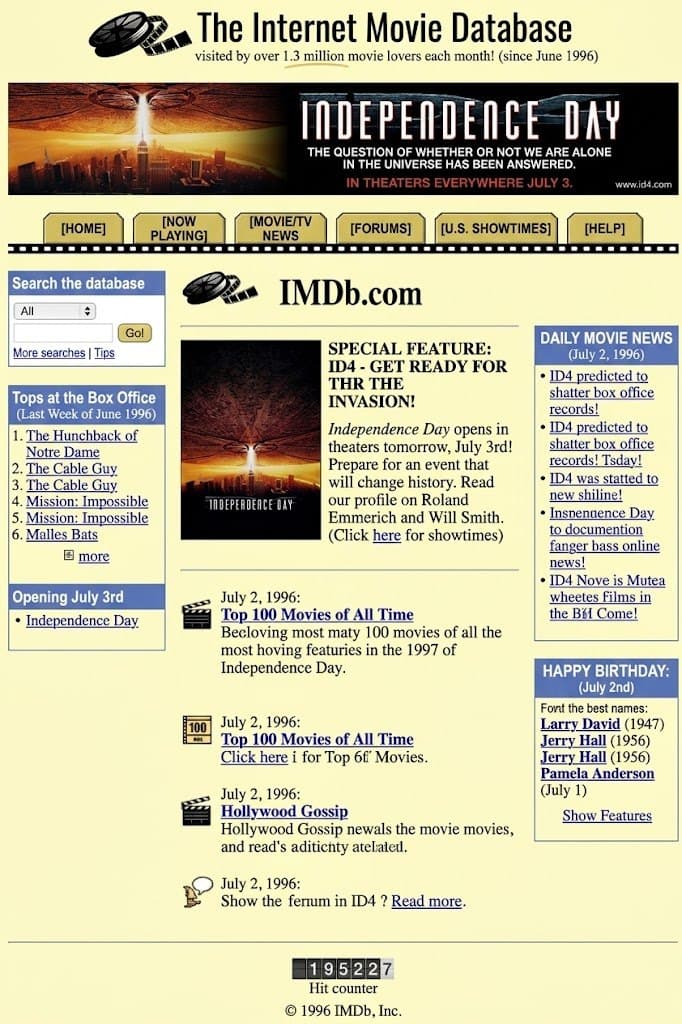
A couple of months after launch came the deal that mattered most. Through a personal connection, de Vallée found himself in the orbit of Roland Emmerich — director and executive producer of that summer’s Independence Day — and producer Dean Devlin, who between them opened the door to 20th Century Fox’s head of marketing. The introduction was theirs; what happened on the other side of it was entirely de Vallée’s. There was no sales team behind him, no playbook, and no precedent to point to — only a proposal built around full ownership of the IMDb home page, timed to the film’s release run-up, at a scale no studio had been offered on the internet before.
20th Century Fox signed. It was IMDb’s first film-studio advertising deal, and one of the first times a major Hollywood studio committed real money to the internet as a channel. The effect went beyond the revenue: once one studio had bought at scale, every other one in town had to form a position on whether it would too. De Vallée had not simply won a sale — he had helped manufacture the category other studios would soon be competing inside.
The US operation was profitable within thirty days of launch. Needham paid off the original credit card debt before the bill came due — the anecdote he has used ever since to argue IMDb was among the world’s first profitable internet companies. That early revenue, generated substantially through de Vallée’s sales operation, gave Needham the confidence to leave Hewlett-Packard and become IMDb’s first full-time employee. Two years later, in April 1998, Amazon acquired IMDb outright — its first-ever acquisition, and confirmation that the audience de Vallée had spent 1996 explaining to skeptical media buyers had been worth exactly what he’d said it was.
What carried forward
Thirty years on, de Vallée — now co-founder of the San Diego-based AI agency Digital Boutique AI — traces a straight line back to that year on Sunset Boulevard. Sell proximity to intent, not the technology carrying it. Move before the market’s rules exist, because a market with no rules is a market nobody can tell you no in. And build the distribution first — IMDb gave its data away free to non-commercial sites and charged only commercial licensees, a structure that let enthusiasts build the audience the paying customers later bought access to.
It is, by his own account, the only deal of his career where he sold something that had genuinely never been sold before, by anyone, to anyone. He has said he’d take the commission-only version of that job again tomorrow.
The through-line is visible in what he is building now. AIDB.Digital — a neutral, cited, continuously refreshed index of the AI industry, every company, model, product and person cross-linked — is the 1996 proposition running thirty years later on different hardware: make the reference complete and consistently right, and the audience that assembles around it becomes the asset. What changed is the subject and the upkeep — the filmography lists companies instead of films, and the contributors are a research agent — but the standard is the one he sold on Sunset Boulevard. See what carried over →

Timeline
 1989Astley Systems, Chelsea Harbour — Apple partner
 1996IMDb launches, timed to the Academy Awards
 +2 wksFirst advertising sale closes
 +2 mo.20th Century Fox signs for Independence Day
 1998Amazon acquires IMDb — its first-ever acquisition, for a reported $55m
- TodayStill Amazon-owned and never valued publicly; outside estimates run into the billions