Your agents don't need a better prompt. They need a harness.
Prompting got one message right. Loops kept one agent running. The next step is the runtime around the model: goals, fan-out, model routing, review, and one chat that runs the rest. Five moves, with a prompt for each.
Most teams still treat a bad agent run as a prompt problem. Reword the instruction, add an example, try again. That worked when the model did one thing per message. It stops working once the model runs for an hour on its own.
What decides the outcome now is everything around the model: what it is aiming at, what it can touch, who checks its work, and where the state lives. That surrounding layer is the harness. Here are five moves for building one, each with a prompt you can paste into Claude Code.
Prompt. Loop. Harness.
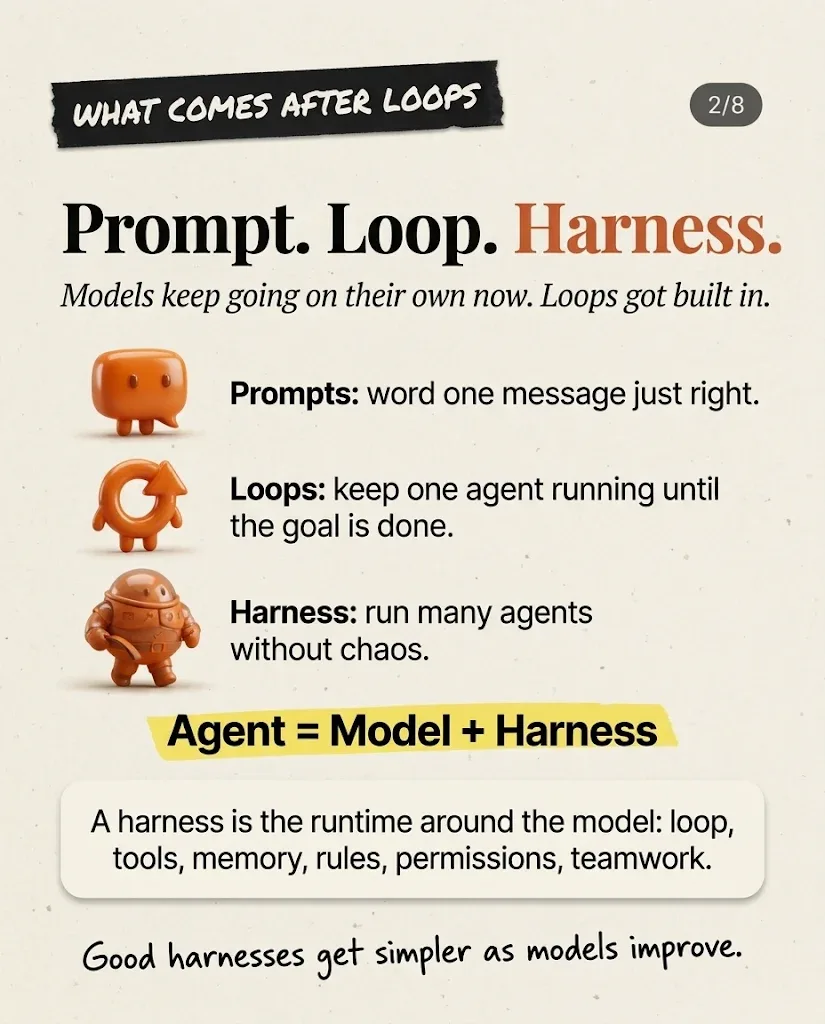
Prompts were about wording one message right. Loops kept one agent running until the goal was done, and models now do that on their own. A harness is the next layer up: the loop, the tools, the memory, the rules, the permissions, and the way several agents share work.
Agent = Model + Harness. One useful sign that you are building it well: a good harness gets simpler as the models improve, because you remove scaffolding instead of adding it.
1. Give a goal, not a step list
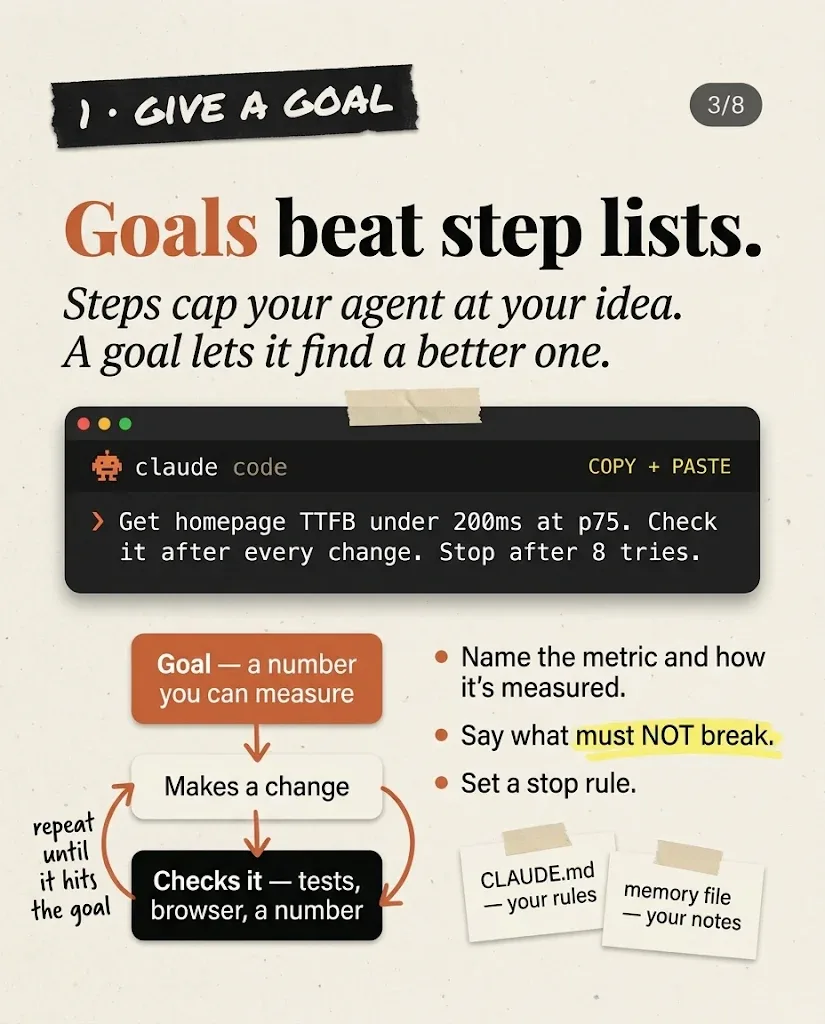
A step list caps the agent at your idea of the solution. A measurable goal lets it find a better one. Give it a number it can check, a way to check it after every change, and a point where it stops.
Name the metric and how it is measured. Say what must not break. Set a stop rule. Put the standing rules in CLAUDE.md and let the agent keep its own notes in a memory file.
Get homepage TTFB under 200ms at p75. Check it after every change. Stop after 8 tries.2. Fan out only truly separate work
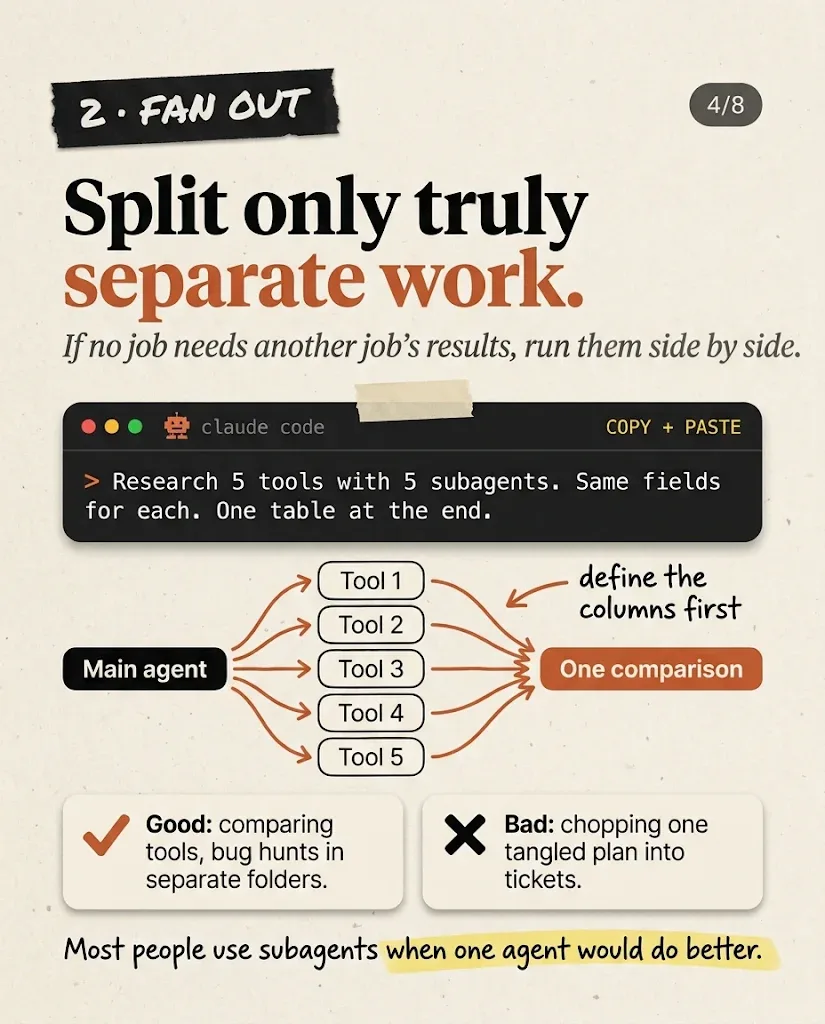
Subagents pay off when no job needs another job's results: comparing tools, or hunting bugs in separate folders. They hurt when you chop one tangled plan into tickets, because the pieces keep needing each other.
Define the output columns before you fan out, so every subagent returns the same shape and the merge is trivial. Most people reach for subagents when one agent would do better.
Research 5 tools with 5 subagents. Same fields for each. One table at the end.3. Match the model to the job
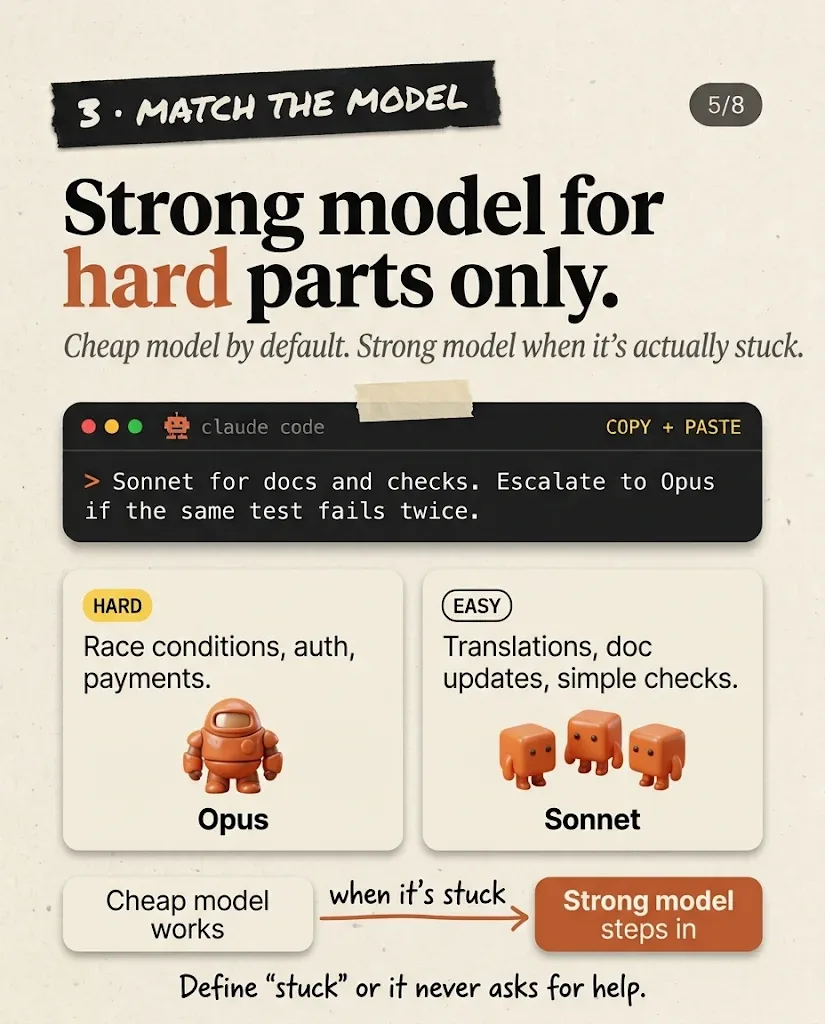
Run the cheap model by default and bring in the strong one only when the work is actually hard: race conditions, auth, payments. Translations, doc updates and simple checks do not need it.
The part people skip is defining stuck. Without a concrete trigger, such as the same test failing twice, the cheap model never asks for help.
Sonnet for docs and checks. Escalate to Opus if the same test fails twice.4. Builder plus reviewer
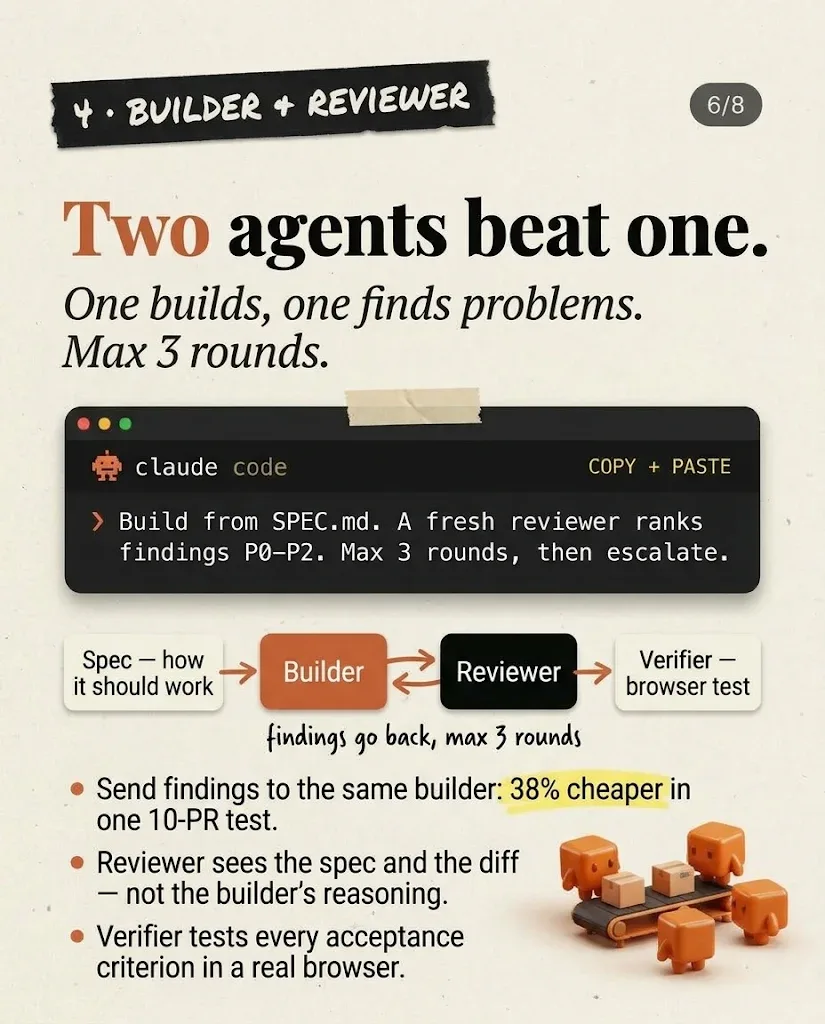
One agent builds from a spec. A fresh reviewer reads the spec and the diff, not the builder's reasoning, and ranks what it finds. A verifier then tests every acceptance criterion in a real browser. Cap it at three rounds, then escalate to a human.
Send the findings back to the same builder rather than starting a new one. It already holds the context, and in one published 10-PR test that made the loop about 38% cheaper.
Build from SPEC.md. A fresh reviewer ranks findings P0–P2. Max 3 rounds, then escalate.5. One chat runs the rest
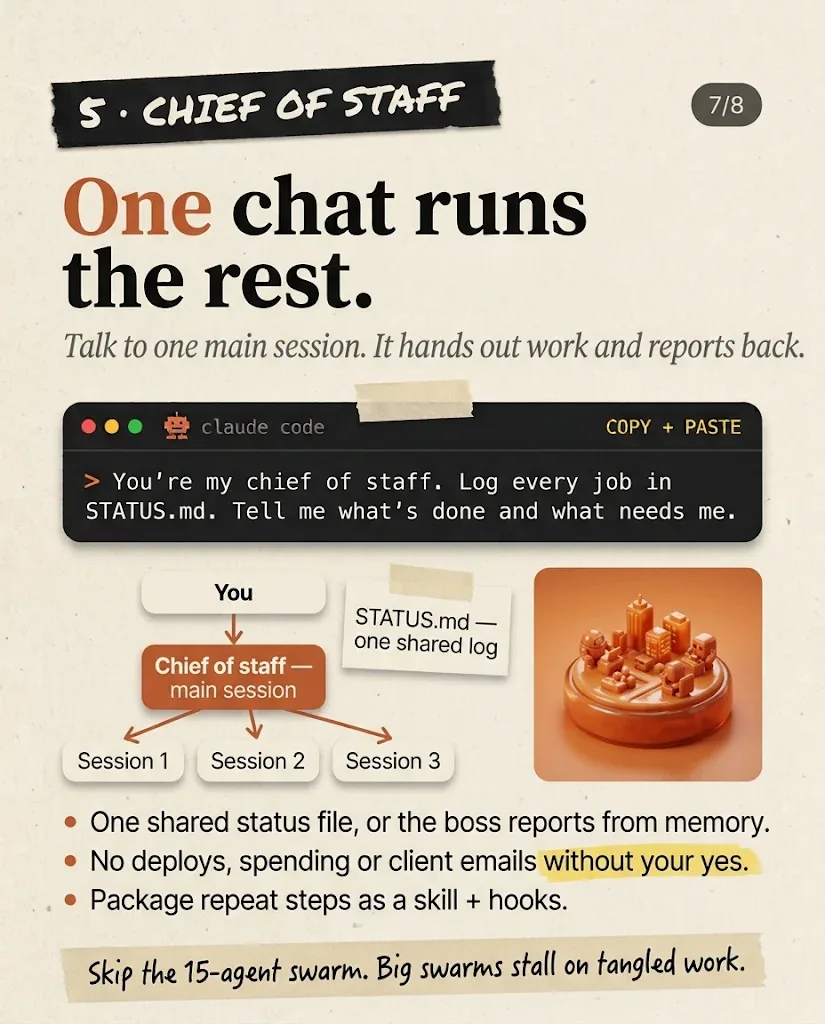
Talk to one main session and let it hand out work to the others and report back. It needs one shared status file, or it reports from memory and drifts.
Keep the irreversible decisions with you: no deploys, spending or client emails without your yes. Package any step you repeat as a skill plus hooks. And skip the fifteen-agent swarm; big swarms stall on tangled work.
You're my chief of staff. Log every job in STATUS.md. Tell me what's done and what needs me.The cheat sheet
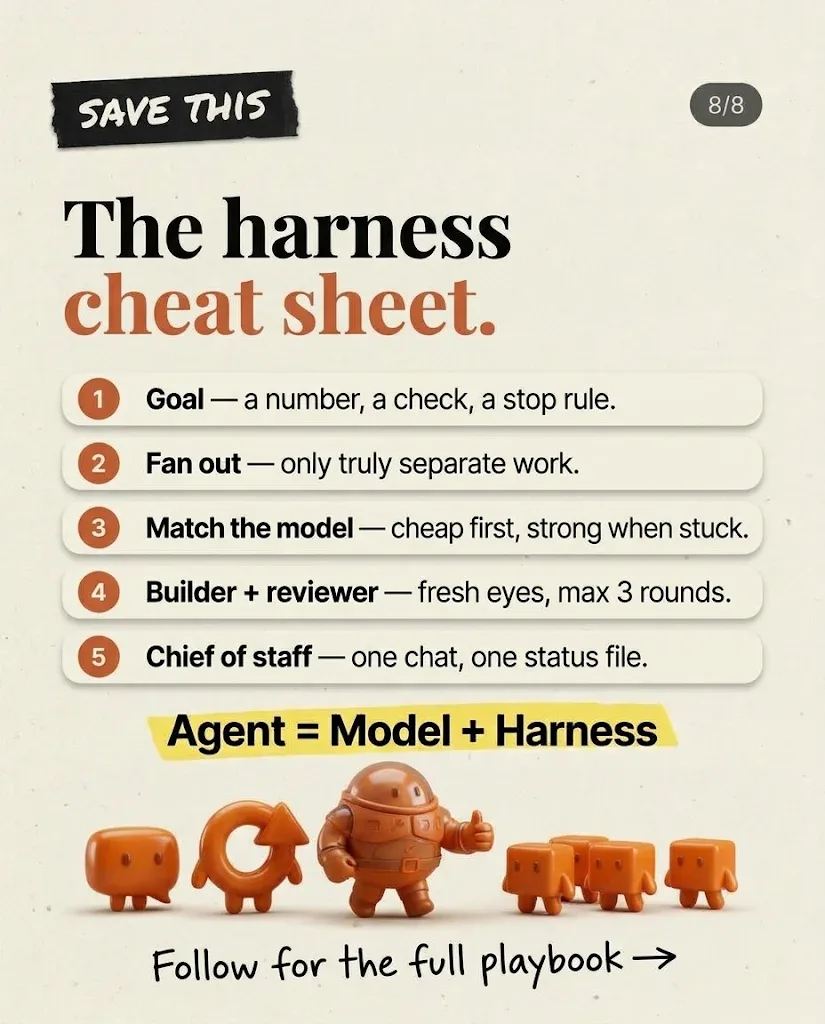
Goal: a number, a check, a stop rule. Fan out: only truly separate work. Match the model: cheap first, strong when stuck. Builder plus reviewer: fresh eyes, max three rounds. Chief of staff: one chat, one status file.
Save the slides, start with the move that fixes your most expensive failure, and add the next one when that one is boring.